When you think of ancient Rome’s greatest achievements, the Colosseum and the Forum likely come to mind first. But some of the most impressive engineering feats of the Roman Empire didn’t happen in marble temples or amphitheaters—they happened in the carefully calculated slopes of the aqueducts that brought fresh water across hundreds of miles of countryside into the heart of the city.
Today, sections of these ancient waterways still stand, offering a tangible connection to Roman innovation and daily life. Unlike the crowded monuments in the city center, the aqueducts often sit in quieter corners of Rome and its surrounding parks, where you can walk beneath their arches and appreciate the scale of what Roman engineers accomplished two thousand years ago.
How Roman Aqueducts Actually Worked

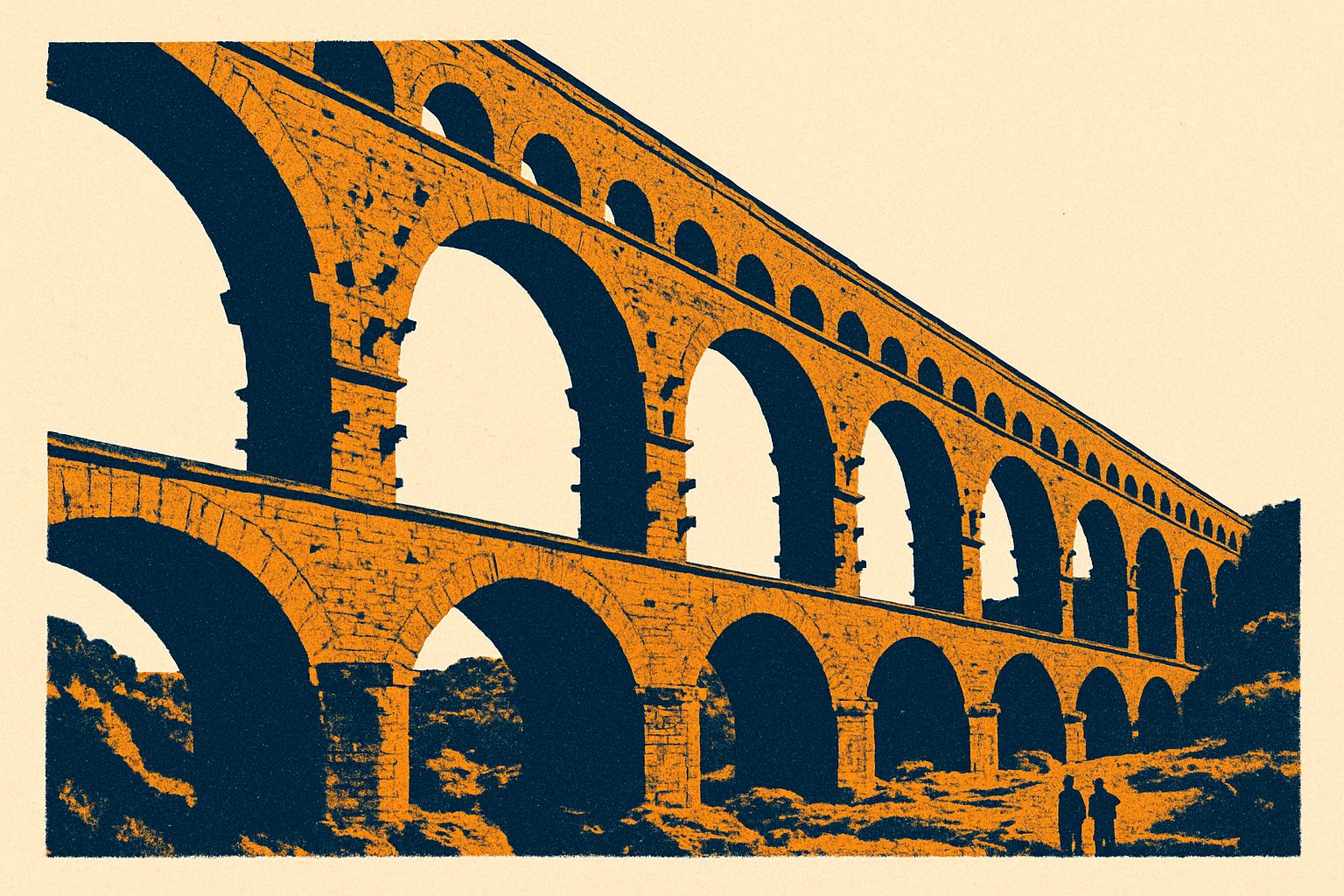
Roman aqueducts weren’t the elevated stone bridges most people picture. Those dramatic arched structures—the ones you see in photos—were only necessary when the water channel needed to cross a valley or uneven terrain. Most of an aqueduct’s length ran underground or at ground level, following the natural contours of the landscape.
The engineering principle was deceptively simple: gravity. Roman engineers surveyed the land with remarkable precision, ensuring the water channel descended at a steady, gentle gradient—typically just a few centimeters per kilometer. Too steep, and the water would erode the channel; too shallow, and it would stagnate.
At its peak, Rome was supplied by eleven major aqueducts, delivering an estimated 1 million cubic meters of water per day to the city’s million inhabitants. That’s more water per capita than many modern cities provide. The water fed public baths, fountains, private homes, and even ornamental features across the urban landscape.
Aqua Claudia and Aqua Anio Novus: The Most Dramatic Ruins

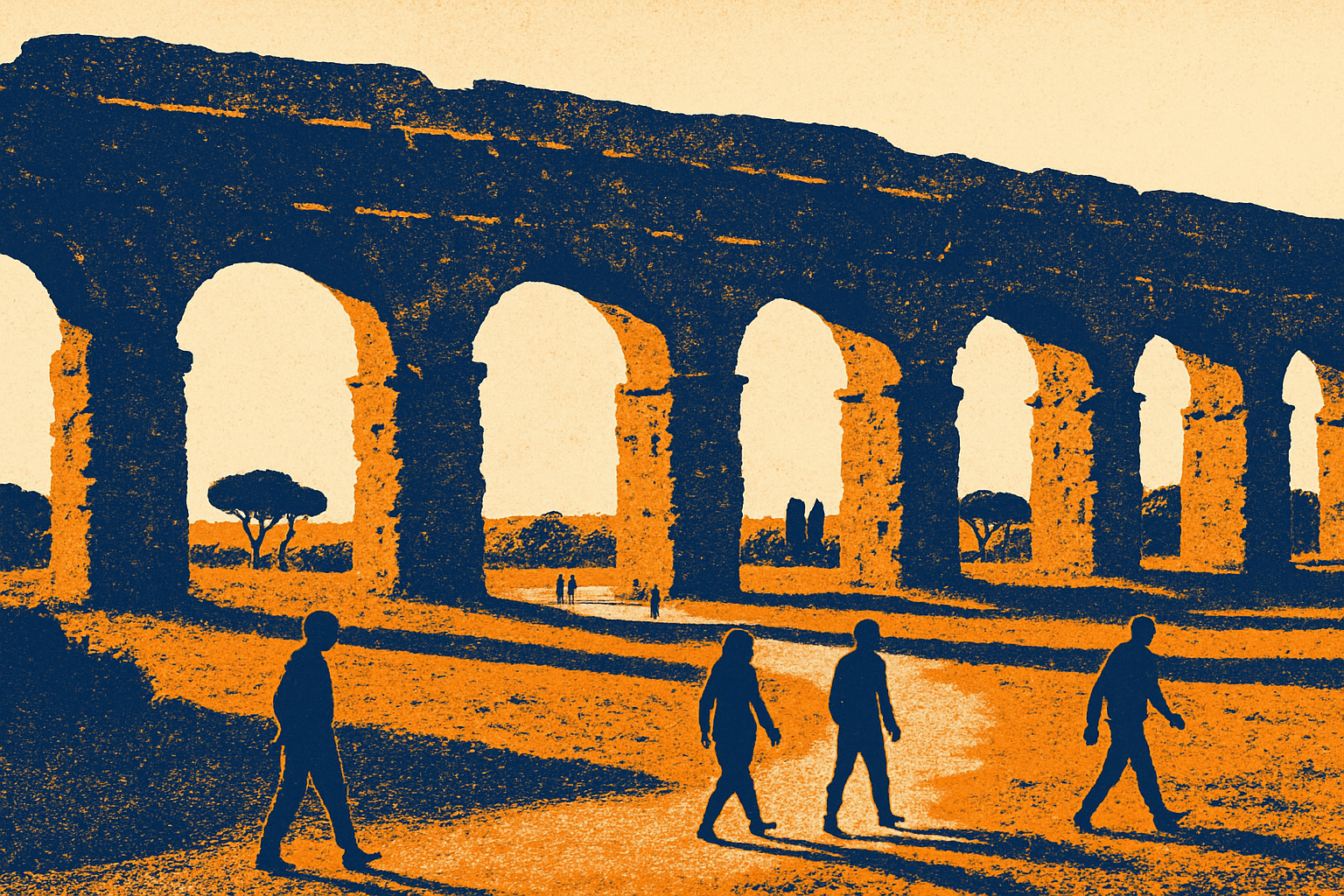
The Aqua Claudia, begun by Emperor Caligula in 38 AD and completed by Claudius in 52 AD, is perhaps the most visually striking aqueduct still standing. Its monumental arches march across Parco degli Acquedotti, a large public park in southeastern Rome that has become one of the city’s most photogenic and undervisited spots.
Here, the arches rise up to 27 meters high, their weathered travertine blocks still stacked without mortar in the Roman manner. The Aqua Anio Novus runs on top of the Aqua Claudia in places—a feat of engineering economy that allowed two separate water sources to share the same support structure.
Walking through Parco degli Acquedotti feels like stepping onto a different planet. The arches stretch into the distance, framed by umbrella pines and wild grasses, with sheep sometimes grazing nearby. It’s a landscape that hasn’t changed dramatically since the Renaissance, when artists came here to sketch ruins.
Where to See Aqueduct Remains in Rome
Parco degli Acquedotti
This is the essential stop for anyone interested in Roman engineering. Multiple aqueducts cross the park, and you can walk freely among and beneath the arches. The park is large and mostly flat, making it ideal for walking or cycling. Late afternoon light is particularly beautiful here.
The park is accessible by metro (Giulio Agricola or Lucio Sestio stations on Line A), though it’s a bit of a walk from either station. Verify current access and transport options before your visit.
Porta Maggiore
In the middle of a busy traffic intersection near Termini station, the Porta Maggiore preserves a dramatic meeting point of two aqueducts—the Aqua Claudia and Aqua Anio Novus—incorporated into the later Aurelian Walls. The scale is impressive: the structure towers over street level, showing how the aqueducts entered the city proper.
Aqua Appia Along Via Appia Antica
The oldest Roman aqueduct, built in 312 BC, ran mostly underground, but you can see some of its infrastructure along the Appian Way archaeological park. While less visually dramatic than the standing arches elsewhere, this is where Rome’s water engineering story began.
Aqua Virgo and the Trevi Fountain
One Roman aqueduct never stopped working: the Aqua Virgo, built in 19 BC. Restored multiple times over the centuries, it still supplies water to several of Rome’s fountains today. Its most famous endpoint is the Trevi Fountain, where the water you see cascading has traveled through an ancient system that predates Christianity.
Why Aqueducts Mattered to Roman Civilization
Water infrastructure was fundamental to Roman identity and power. A city’s status was measured partly by the quality and abundance of its water supply. Rome’s elaborate network of aqueducts, fountains, and baths wasn’t just functional—it was a statement about Roman engineering superiority and the civilization that came with it.
The public baths, which required enormous quantities of water, served as social centers where Romans of different classes mingled, conducted business, exercised, and debated. Without the aqueducts, this central Roman institution couldn’t have existed.
When the aqueducts fell into disrepair after the fall of the Western Roman Empire, Rome’s population collapsed from over a million to perhaps 30,000 by the early Middle Ages. The correlation wasn’t coincidental—without water infrastructure, the city couldn’t sustain a large population. Medieval Rome clustered along the Tiber, the only reliable water source remaining.
Technical Innovations That Defined Roman Engineering
Roman aqueduct builders developed several innovations that remained standard for centuries:
- Surveying instruments: The groma and chorobates allowed engineers to maintain precise gradients over enormous distances
- Arch construction: The repeated arch design distributed weight efficiently and became a signature of Roman architecture
- Hydraulic cement: A concrete that could set underwater allowed construction in rivers and wet conditions
- Settling tanks: Built at intervals to allow sediment to drop out, extending the system’s working life
- Distribution networks: Castellum divisorium structures split the water flow into multiple channels for distribution across the city
These weren’t theoretical exercises. They were practical solutions developed through trial, error, and accumulated expertise across generations of builders.
Planning Your Aqueduct Visit
The aqueduct sites are spread across different parts of Rome and its periphery. Here’s what to keep in mind:
Timing: Early morning or late afternoon light makes for better photography and more comfortable walking, especially in Parco degli Acquedotti, which has limited shade. Spring and fall offer the most pleasant weather.
Combining sites: Parco degli Acquedotti deserves at least two hours if you want to walk the length of the visible structures. It’s not near the central tourist sites, so plan it as a separate half-day excursion or combine it with a visit to the Via Appia Antica, which is in the same general direction from the city center.
Practical matters: Parco degli Acquedotti is an open public park with no formal entrance or facilities. Bring water and sun protection. The ground is uneven in places—sturdy walking shoes are recommended.
Historical context: The ruins are impressive on their own, but understanding what you’re looking at multiplies the experience. A knowledgeable guide can explain the engineering principles, point out details you’d otherwise miss, and place the structures in their historical and urban context.
Beyond the Tourist Circuit
What makes the aqueducts special for many visitors is precisely that they’re not on the standard Rome itinerary. You won’t find the crowds that pack the Forum or the Vatican. Instead, you’ll find local families having picnics, joggers, and the occasional shepherd with a flock—a slice of Roman life that exists parallel to the tourist center.
This is Rome’s layered history made tangible: ancient infrastructure still standing in a modern city, neither restored into a museum piece nor completely ruined, just present—part of the landscape, part of daily life, still there after two millennia.
For travelers interested in how cities actually worked, how empires built the infrastructure that sustained them, and how engineering shaped civilization, Rome’s aqueducts offer something the ornamental monuments can’t: a glimpse of the practical genius that made everything else possible.
If you’d like to explore Rome’s ancient engineering with expert insight into both the technical and historical context, Trip in Art offers small-group experiences that go beyond the standard sites to reveal the ingenuity that built an empire.