Rome’s ancient markets were far more than places to buy bread and olive oil. They were centers of economic power, political influence, and social exchange—places where senators rubbed shoulders with merchants, where news spread faster than in the Forum, and where the wealth of an empire was bought, sold, and displayed.
Today, several of these markets survive as archaeological sites, architectural monuments, and living neighborhoods. Understanding them offers a different lens on Roman life: not just emperors and temples, but the infrastructure that kept a million people fed, clothed, and connected.
Trajan’s Market: The World’s Oldest Shopping Mall
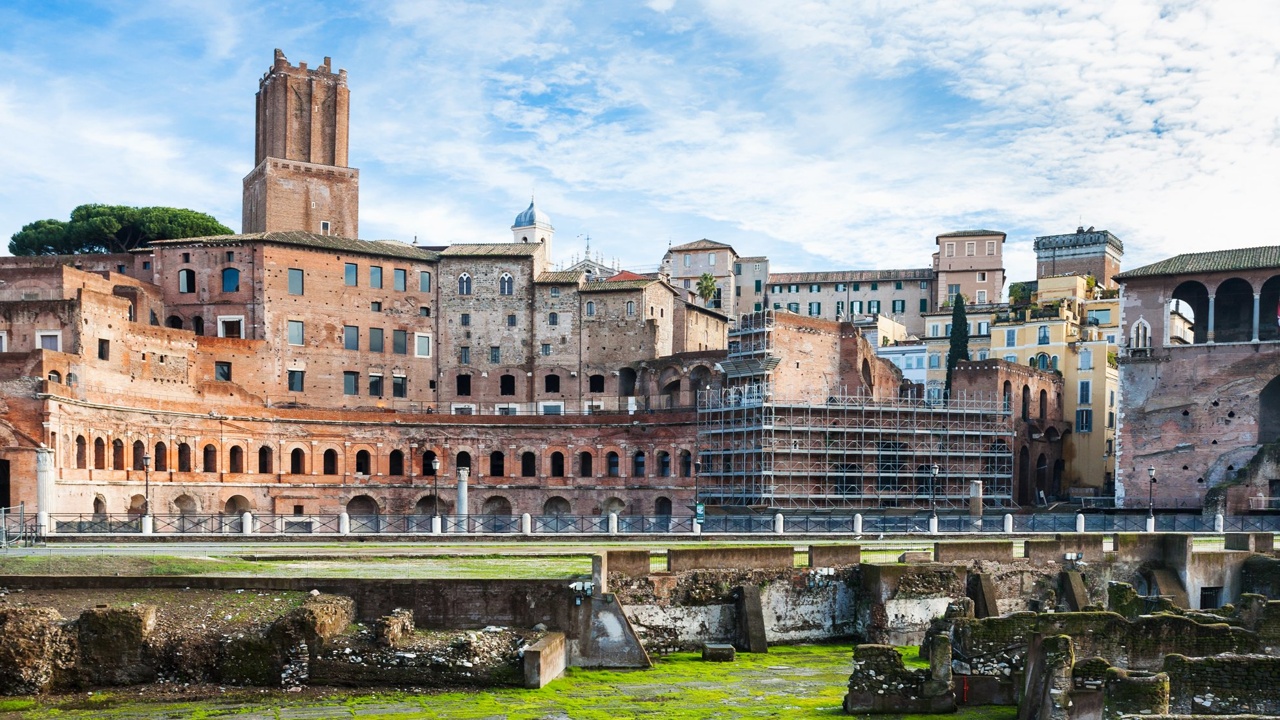
Built between 100 and 110 CE under Emperor Trajan, this massive complex on the slopes of the Quirinal Hill is often called the world’s first shopping mall—a claim that oversimplifies but captures its scale. Designed by the architect Apollodorus of Damascus, the structure included over 150 shops and offices arranged on multiple levels, connected by corridors, staircases, and a central street.
The market sold everything: spices from the East, wine from Campania, grain from Egypt, textiles, pottery, and luxury goods. The ground floor housed retail spaces; upper levels contained administrative offices. The semicircular façade in brick-faced concrete was an engineering marvel, built into the hillside to create a stable, multi-story commercial district.
Today, the site functions as the Museo dei Fori Imperiali, with exhibits on the Imperial Fora and excellent views over the Forum of Trajan below. The vaulted halls, intact staircases, and layered spaces give a tangible sense of ancient retail life. Verify current opening hours on the official museum site before your visit.
The Forum Boarium: Rome’s Cattle Market
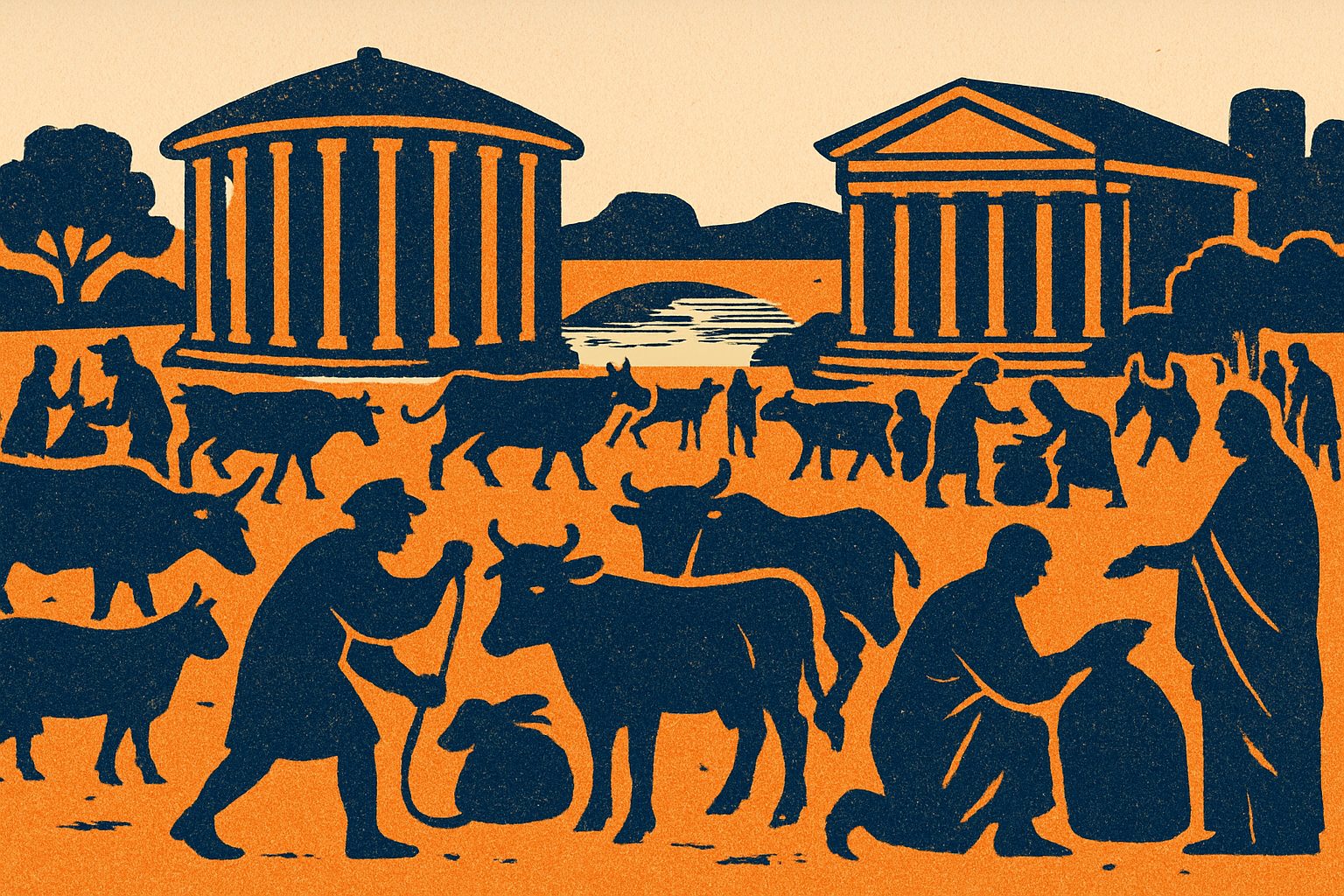
The Forum Boarium, located between the Capitoline Hill and the Tiber River, was one of Rome’s oldest market areas—active from the early Republic through the Imperial period. Originally a cattle market (hence the name), it grew into a broader commercial hub thanks to its location near the river port.
Two remarkably preserved temples stand here: the round Temple of Hercules Victor (late 2nd century BCE) and the rectangular Temple of Portunus (2nd–1st century BCE). Both are among the best-preserved sacred structures in Rome, their survival owed partly to later conversion into Christian churches.
The area also held the Ara Maxima, an ancient altar dedicated to Hercules, and was a key point for goods arriving by river. Walking through Piazza Bocca della Verità today, you’re standing in what was once the commercial gateway to the city.
The Forum Holitorium: Vegetable Market and Sacred Ground
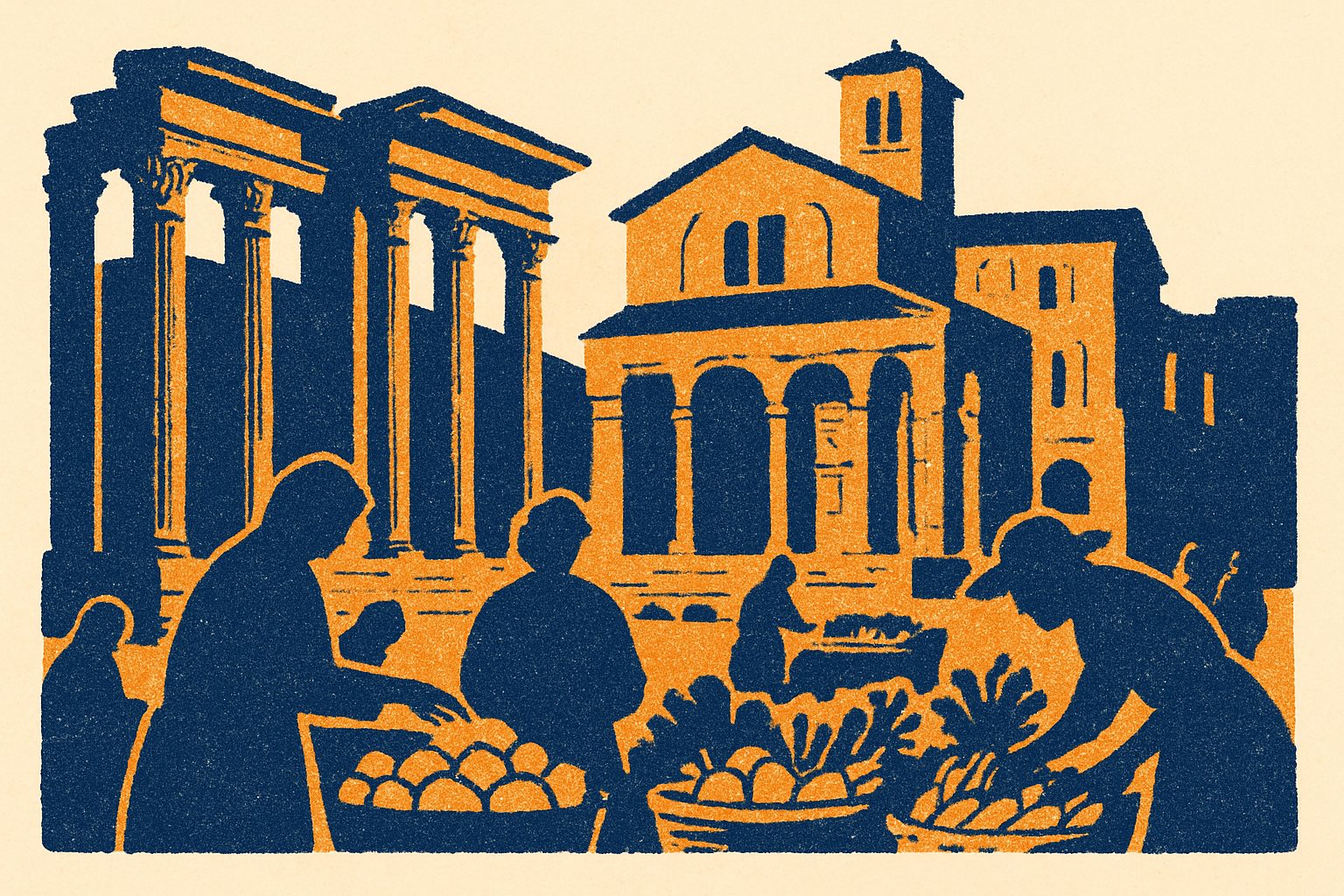
Just north of the Forum Boarium lay the Forum Holitorium, the ancient vegetable market. Three Republican-era temples once stood here, dedicated to Janus, Juno Sospita, and Spes (Hope). Parts of these temples—columns, podiums, walls—were incorporated into the medieval church of San Nicola in Carcere, which still stands on the site.
The church offers a fascinating palimpsest: ancient columns embedded in Renaissance walls, visible temple foundations in the crypt, and archaeological layers that tell the story of continuous use from the 3rd century BCE to today. Guided visits to the underground areas reveal the temple podiums and Roman street levels.
Porticus Aemilia: The Warehouse District
South of the Aventine Hill, near the ancient river port, stood the Porticus Aemilia—a colossal warehouse complex built in 193 BCE and later expanded. Stretching nearly 500 meters long and 60 meters wide, it was used to store goods arriving by ship: grain, wine, oil, and imports from across the Mediterranean.
The structure’s parallel barrel vaults, supported by massive travertine piers, represented cutting-edge Roman engineering. Substantial ruins survive today along Via Rubattino and Via Branca, though they’re not always accessible to the public. The scale alone—visible from the street—conveys the logistical sophistication required to feed ancient Rome.
Markets in the Imperial Fora
Each of the Imperial Fora—built by Julius Caesar, Augustus, Vespasian, Nerva, and Trajan—included commercial spaces alongside temples and basilicas. These weren’t markets in the narrow sense, but the colonnaded porticoes that lined the fora housed shops, offices, and moneychangers.
The Forum of Caesar, for instance, had a double colonnade where luxury goods were sold. The Forum of Augustus featured shops in its exedrae. The integration of commerce into these grand public spaces reflected Roman pragmatism: even the most ceremonial settings had economic functions.
When to Visit and What to Expect
The archaeological sites of Trajan’s Market, the Forum Boarium temples, and San Nicola in Carcere can all be visited independently. Trajan’s Market is an enclosed museum with ticketed entry; the temples at Forum Boarium are visible from the outside at any time, and San Nicola offers guided underground tours on certain days.
The best times to visit are early morning or late afternoon, particularly in warmer months. These sites draw fewer crowds than the Colosseum or Roman Forum, offering a quieter experience for those interested in the commercial and architectural layers of ancient Rome.
Bring comfortable shoes—many of these sites involve uneven ancient paving, staircases, and outdoor walking. A basic understanding of Roman urban layout helps, but on-site information panels (often in Italian and English) provide context.
Why These Markets Matter
Rome’s markets tell a story that the temples and triumphal arches don’t: how a pre-industrial city of a million people functioned day to day. They reveal supply chains, engineering solutions, social stratification, and the empire’s economic reach.
They also show continuity. The Forum Boarium remained a market area into the Middle Ages. Trajan’s Market influenced Renaissance and Baroque urban design. San Nicola in Carcere is still an active parish church. These aren’t dead ruins—they’re places where Roman infrastructure shaped everything that came after.
For travelers interested in archaeology, architecture, or the material culture of the ancient world, Rome’s markets offer substance and specificity often missing from more famous monuments.
Plan Your Visit
If you’re planning a trip to Rome and want to explore the city’s commercial and archaeological heritage in depth, consider joining a guided small-group visit with experts who can bring these layered sites to life. Trip in Art specializes in art, archaeology, and history experiences that go beyond the surface, designed for curious travelers who want to understand what they’re seeing.