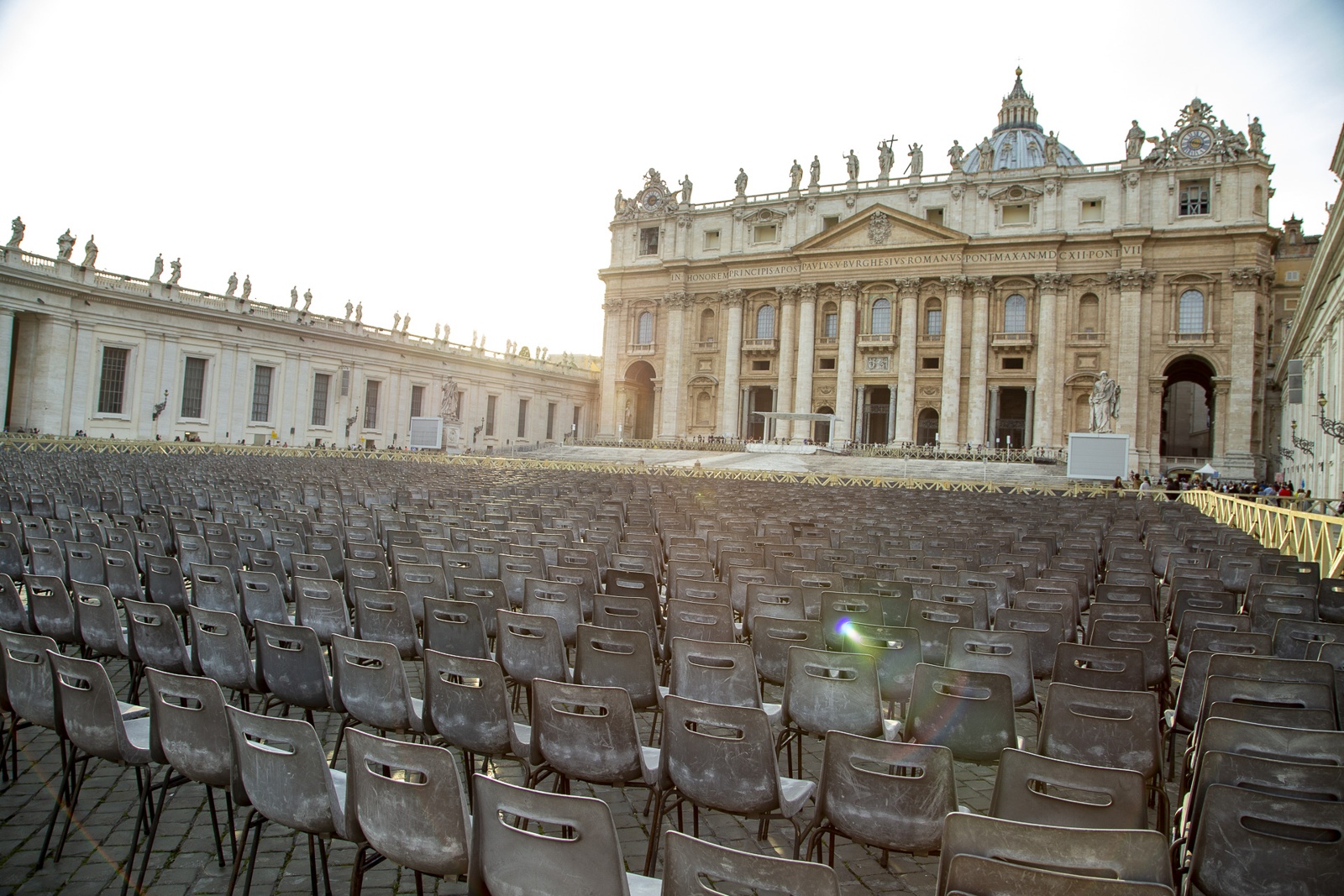
St. Peter’s Basilica isn’t just the largest church in Christendom—it’s a layered anthology of Renaissance and Baroque genius, built over 120 years by the greatest architects and artists of their age. Walking through its interior means navigating centuries of ambition, devotion, and artistic competition compressed into a single, overwhelming space.
This guide takes you through the basilica’s essential artworks, architectural highlights, and the dome climb, with practical notes on when to visit and what deserves your attention.
The Pietà: Michelangelo’s Early Masterpiece
Just inside the main entrance, in the first chapel on your right, sits Michelangelo’s Pietà (1498–1499). He carved it at twenty-three, and it remains the only work he ever signed—his name runs across the sash on Mary’s chest.
What makes it extraordinary isn’t just the technical skill—the way drapery folds or flesh seems soft against stone—but the psychological restraint. Mary holds her dead son with a grief that’s inward, contemplative, almost serene. It’s a radical departure from the anguished Pietàs common in Northern Europe at the time.
The sculpture sits behind bulletproof glass after a 1972 vandalism attack. Even from a distance, the luminosity of the Carrara marble and the anatomical precision are unmistakable.
The Nave and Comparative Scale Markers
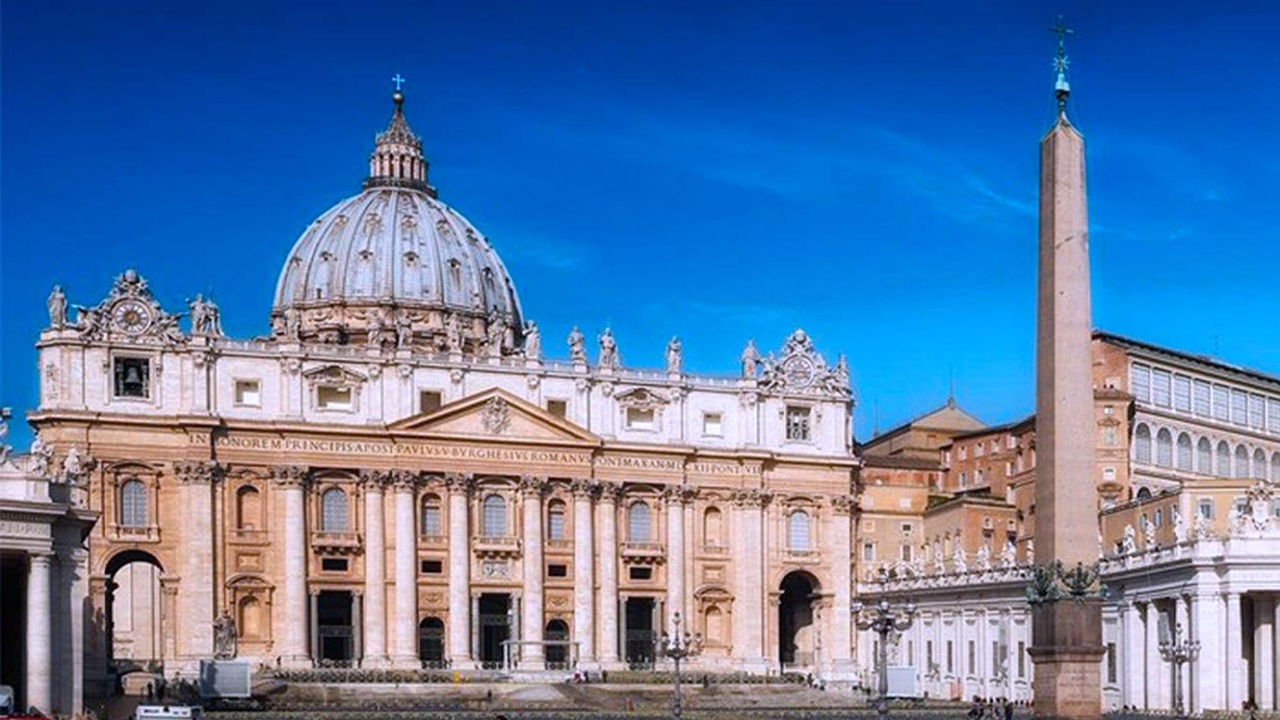
The central nave stretches 186 meters from entrance to apse, and the interior volume is so vast that your spatial sense fails almost immediately. To help visitors grasp the scale, bronze plaques set into the floor mark the lengths of other major cathedrals—St. Paul’s in London, the Florence Duomo—all of which fit comfortably inside St. Peter’s.
The barrel vault overhead, designed by Michelangelo and completed by Giacomo della Porta, soars to 46 meters. The proportions are so carefully calculated that the true scale only hits you gradually, as you walk deeper and familiar reference points dissolve.
Bernini’s Baldachin: The Bronze Canopy
At the crossing, directly beneath the dome, rises Bernini’s Baldachin (1623–1634)—a bronze canopy standing nearly 29 meters high, held aloft by four twisted columns inspired by ancient spiral columns believed to have come from Solomon’s Temple.
Pope Urban VIII commissioned it, and Bernini melted down bronze from the Pantheon’s portico to cast it—a decision that earned Urban the famous Roman pasquinade: “What the barbarians didn’t do, the Barberini did.”
The Baldachin marks the site of St. Peter’s tomb, excavated in the mid-20th century and visible through a small opening in the floor. It’s also a hinge between Renaissance architecture and Baroque theatricality—Bernini’s columns twist upward with a dynamic energy that contrasts sharply with Michelangelo’s measured geometry overhead.
The Dome: Architecture and the Climb
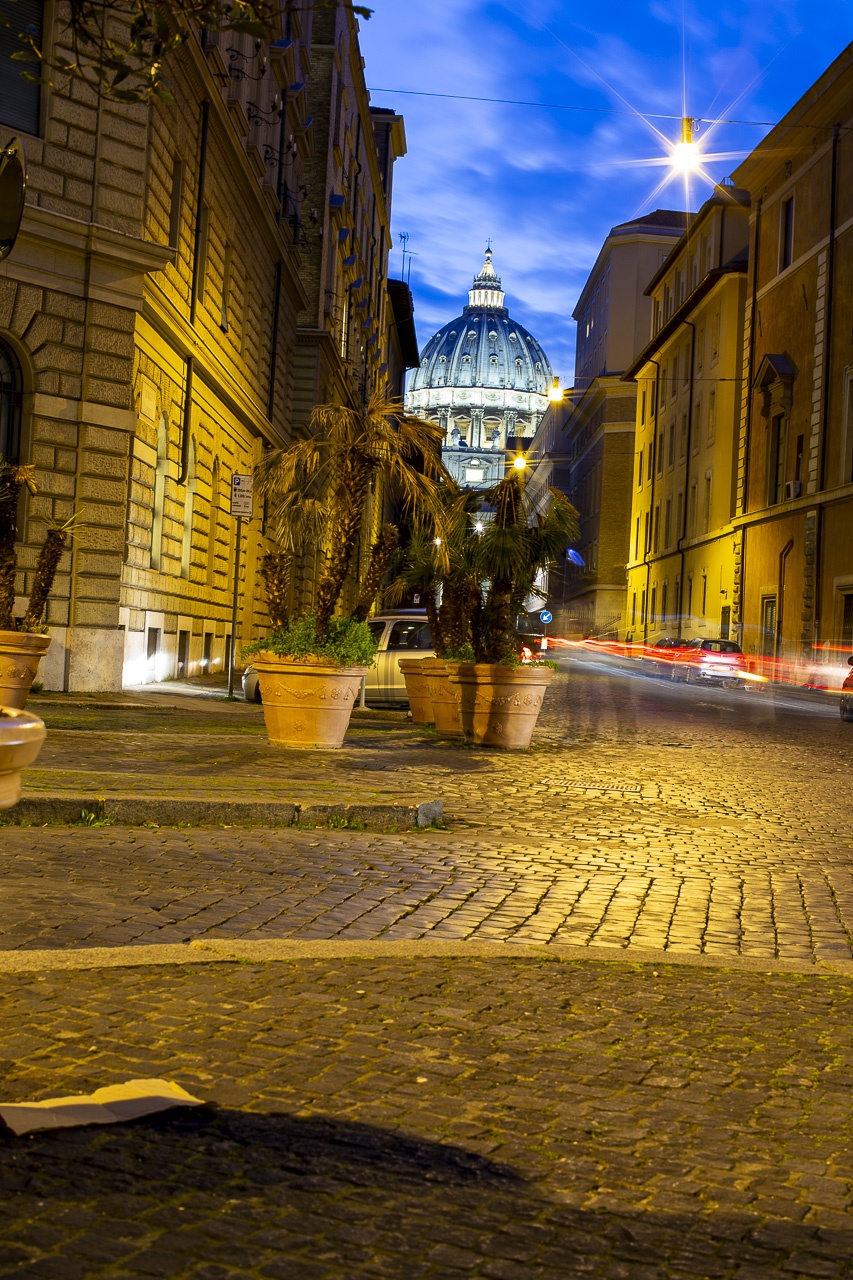
Michelangelo’s dome, completed after his death by Giacomo della Porta and Domenico Fontana, dominates the Roman skyline. From inside the basilica, the view upward reveals the coffered interior, mosaics of saints and angels, and an oculus inscribed with Christ’s words to Peter: “Tu es Petrus.”
The dome climb is accessed via a separate entrance to the right of the basilica façade. You can take an elevator partway, but the final 320 steps are unavoidable—and they narrow as you spiral upward between the inner and outer shells of the dome itself.
At the interior gallery, you’re level with the base of the dome, looking down into the basilica from a dizzying height. The mosaics that seem delicate from the floor are revealed as massive tessera, each one the size of a book.
The final climb takes you outside, onto the lantern’s exterior gallery. The 360-degree view over Rome and Vatican City is unmatched, but the passageways are tight, steep, and not suitable for anyone with mobility concerns or claustrophobia.
When to Climb
Mornings, especially early in the week, see lighter crowds. Midday heat in summer makes the climb punishing—there’s no climate control inside the dome structure. Late afternoon offers softer light for photography, but queues can build. The best times to visit are spring and fall when temperatures are moderate.
Chapels, Monuments, and Overlooked Masterpieces
Beyond the major highlights, St. Peter’s is dense with significant art. The Chapel of the Choir (Cappella del Coro) features a 16th-century wooden choir stall and stucco work often ignored by hurried visitors. Nearby, Bernini’s monument to Pope Alexander VII (1671–1678) uses draped marble to create the illusion of fabric spilling over the tomb—a Baroque flourish that borders on trompe-l’œil.
In the apse, the Cathedra Petri—a gilded bronze throne encasing what tradition holds to be the wooden chair of St. Peter—floats above the altar, framed by angels and bathed in light from an alabaster window. It’s pure Bernini theater, completed in 1666.
Don’t overlook Antonio Canova’s monument to the Stuart pretenders (1817–1819) in the left aisle—a Neoclassical elegy to a dynasty that died in Roman exile, its restraint contrasting sharply with the Baroque exuberance elsewhere.
The Treasury Museum
A small entrance in the left transept leads to the Treasury (Tesoro), a museum housing liturgical objects, papal tiaras, and relics spanning centuries. Highlights include the 4th-century sarcophagus of Junius Bassus, with its intricate relief carvings, and Bernini’s silver model of the Baldachin.
It’s easy to skip, but if you have an interest in devotional art or ecclesiastical history, the Treasury offers context often missing from the basilica floor itself.
Visiting Practicalities
Entry to the basilica is free, but security lines can stretch for an hour or more during peak season and holidays. Dress code is strictly enforced: shoulders and knees must be covered. Large bags are not permitted.
The dome climb requires a separate ticket, available at the entrance to the climb or online. If you want to beat the crowds, book your timed entry in advance and arrive when doors open—typically 7:00 or 8:00 AM depending on the season.
Guided small-group visits offer the advantage of expert interpretation and entering with your group at your scheduled time, which can make navigating the space far less chaotic. A knowledgeable guide helps decode the layered iconography and architectural decisions that aren’t immediately legible to the casual visitor.
Why St. Peter’s Interior Demands Time
You can race through St. Peter’s in thirty minutes, hitting the Pietà, snapping a photo of the Baldachin, and calling it done. But the basilica rewards slower looking. It’s a compendium of artistic ambition, theological argument, and architectural problem-solving that took more than a century to resolve.
The interplay between Michelangelo’s geometry and Bernini’s drama, the way light falls through the dome, the sheer accumulation of artistic effort—these aren’t things you absorb in a single pass. St. Peter’s interior is not a monument to see; it’s a space to read, layer by layer.
If you’re planning a visit and want expert insight into the art, architecture, and history that make St. Peter’s essential, explore the curated experiences at Trip in Art—designed for travelers who want substance, not spectacle.