Why Trevi Fountain Matters
Trevi Fountain isn’t just Rome’s most photographed monument—it’s the culmination of two thousand years of hydraulic engineering, wrapped in a baroque spectacle that turned a simple water terminus into theatre.
The fountain marks the endpoint of the Acqua Vergine, an aqueduct built in 19 BCE that still supplies water to central Rome. What you see today—26 meters high, 49 meters wide—was designed by Nicola Salvi and completed in 1762 by Giuseppe Pannini, turning a utilitarian water source into a stage set where gods, tritons, and allegorical figures perform an eternal drama about mankind’s relationship with water.
It matters because it does something rare: it makes infrastructure poetic.
The Aqueduct Behind the Spectacle
The Acqua Vergine has been flowing for over two millennia. According to legend, Roman soldiers discovered the spring after a young virgin showed them the way—hence the name.
Unlike most Roman aqueducts, the Vergine runs entirely underground and survived the barbarian invasions that destroyed Rome’s other water systems. Throughout the Middle Ages, it remained the city’s only functioning aqueduct, feeding modest fountains across the Campo Marzio district.
The current fountain was commissioned by Pope Clement XII in 1730. Salvi won the competition but didn’t live to see it finished—he died in 1751, and the project was completed by Giuseppe Pannini eleven years later.
Reading the Fountain: What You’re Actually Looking At
The facade mimics a triumphal arch, but instead of celebrating military conquest, it celebrates water’s conquest over aridity.
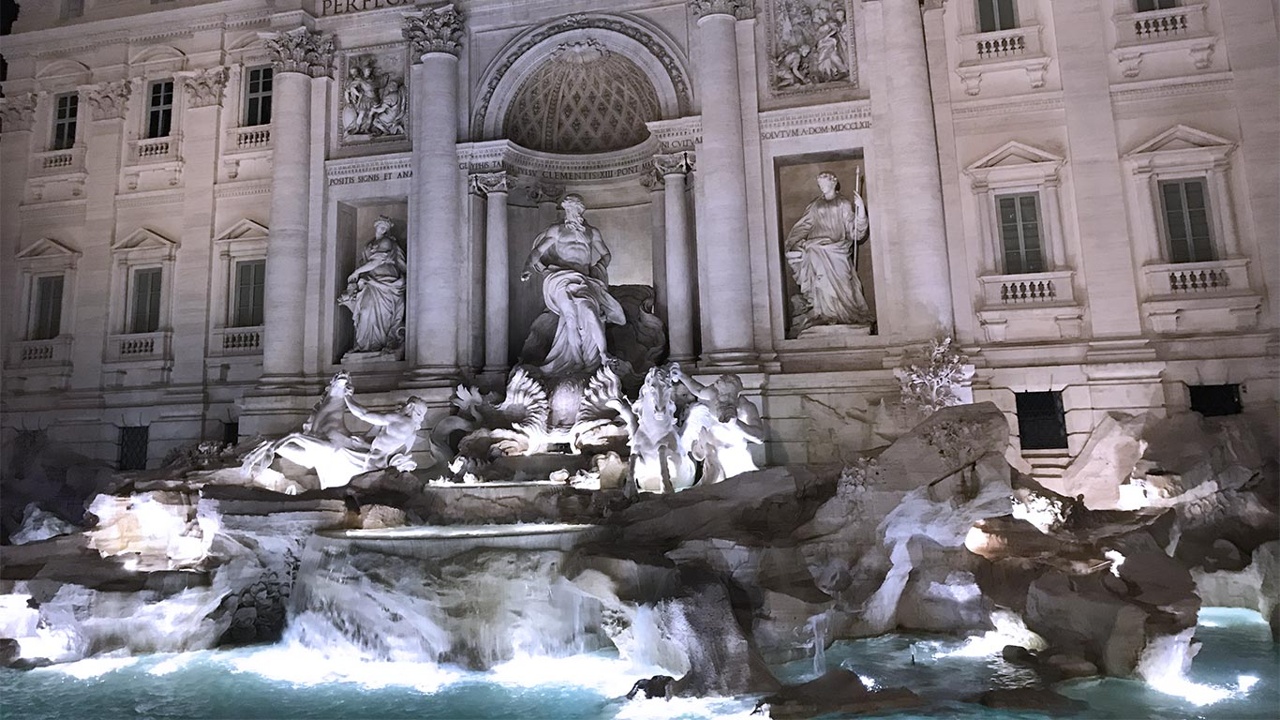
At the center: Oceanus, the Titan god of water, stands in a shell-shaped chariot pulled by two sea horses—one wild, one calm—representing the sea’s dual nature. Two Tritons guide them.
Above Oceanus, two relief panels show the virgin pointing soldiers to the spring (left) and Agrippa approving the aqueduct’s construction (right).
At the fountain’s summit, four statues represent the seasons. Beneath them, allegorical figures of Abundance and Health flank Oceanus, reminding viewers that water brings both prosperity and wellbeing.
The rocks are travertine sculpted to look rough and natural—artificial nature framing the sculpted figures in deliberate contrast.
The Architectural Trick
Salvi faced a problem: the piazza is tiny and asymmetrical. Viewers can’t step back far enough to see the whole composition at once.
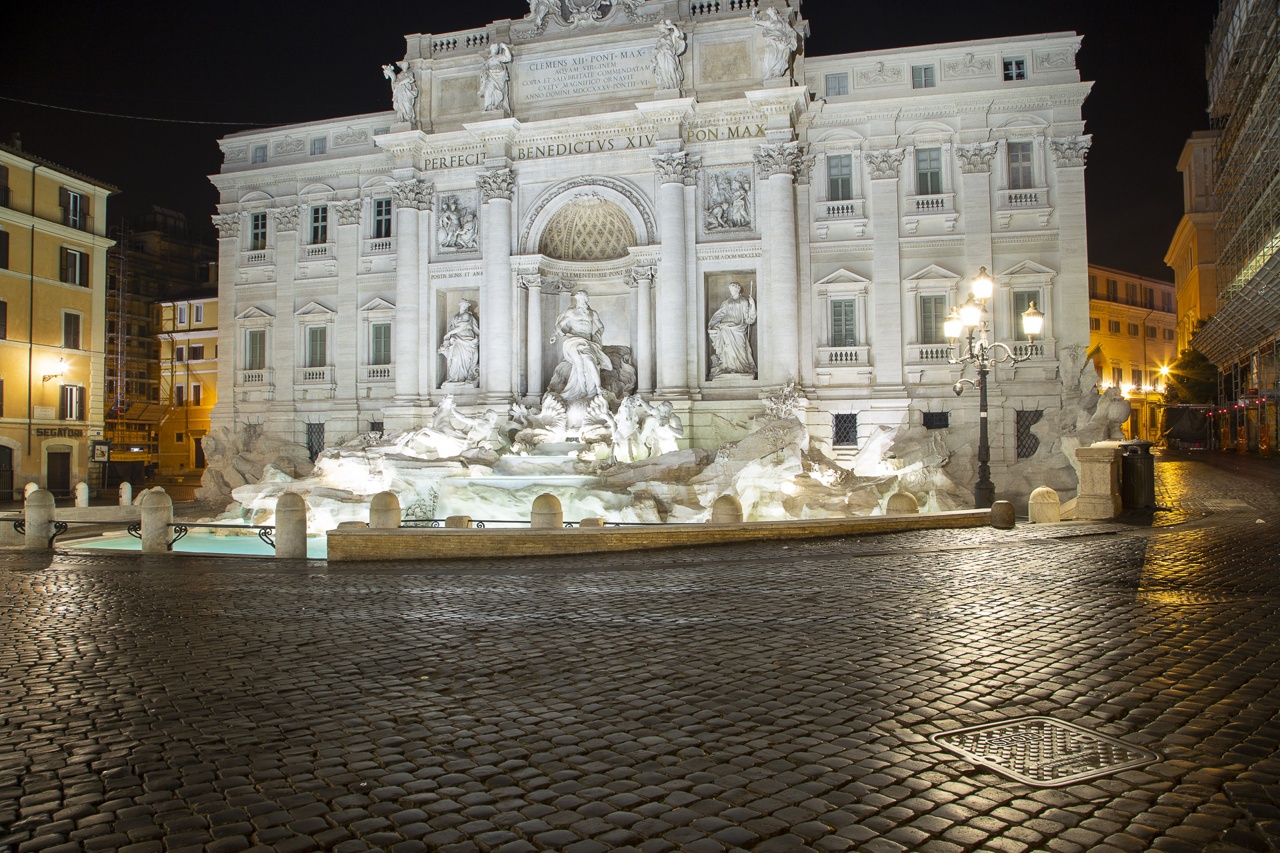
His solution: he embedded the fountain into Palazzo Poli behind it, making architecture and fountain a single organism. The rusticated basement, the flowing water, the building’s facade—they read as one continuous surface. It’s scenographic architecture, designed to be experienced frontally, like a stage set.
The Coin Ritual: Origin and Reality
The coin-tossing tradition is surprisingly recent. It was popularized by the 1954 film “Three Coins in the Fountain,” though earlier travelers had tossed coins into Roman fountains as votive offerings.
The ritual: stand with your back to the fountain, toss one coin with your right hand over your left shoulder. Supposedly, this guarantees your return to Rome.
Two coins mean you’ll fall in love with an attractive Italian. Three coins mean you’ll marry them. The mythology scales up from there.
Reality: the city collects around €1.5 million annually from the fountain. The money is donated to Caritas, a Catholic charity supporting Rome’s vulnerable populations. Workers sweep coins daily before dawn.
Other Legends Worth Knowing
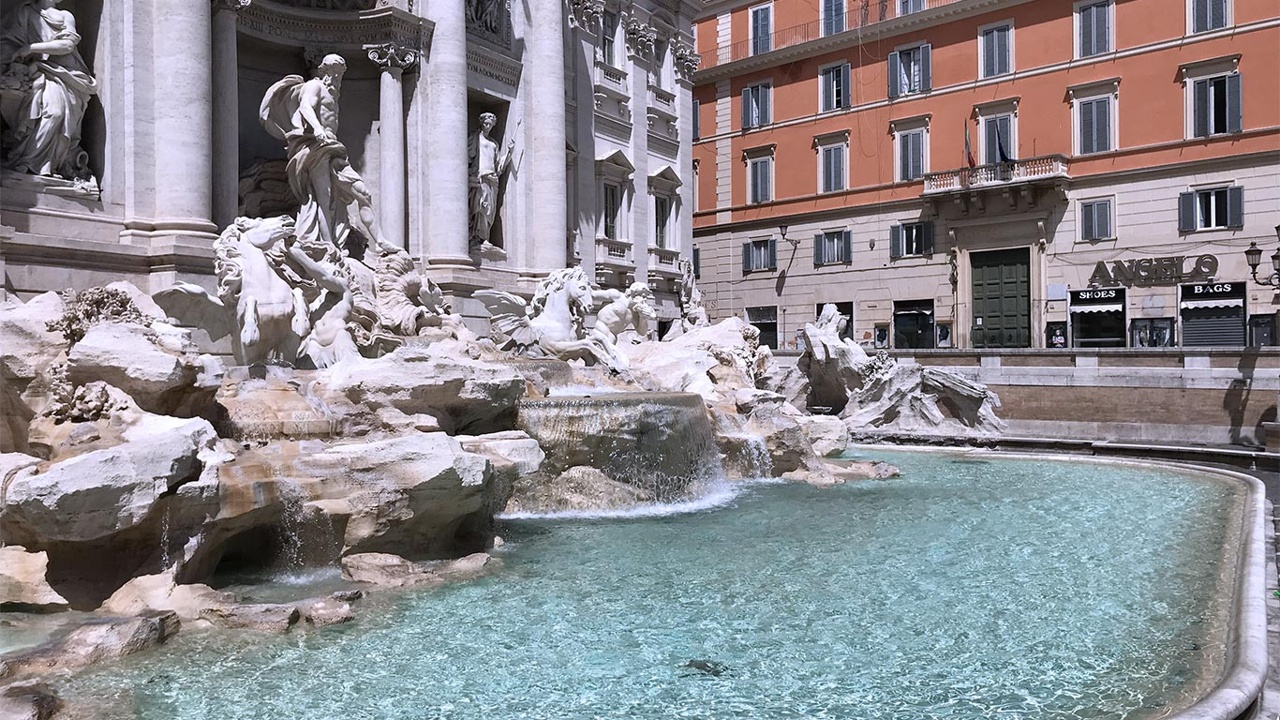
The “asso di coppe” (ace of cups) is a small stone vase on the fountain’s right side. Legend says Salvi placed it there to block the view of a barber who constantly criticized his work. Not true—the vase is a signature element in several Salvi projects—but the story persists.
Another belongs to the small basin with two spouts set to the right of the fountain, away from the main show: the fontanella degli innamorati, the lovers’ fountain. Tradition held that a couple who drank there would stay faithful to one another—a woman whose man was leaving Rome would hand him water in a new glass and then break it. Note what the legend actually promises: love, not a return to Rome. The return is the coin. And it belongs to the past—today you look at it, you don’t drink from it.
The Best Times to Visit Trevi Fountain
Trevi is never empty. Its tiny piazza and global fame guarantee crowds from breakfast until well past midnight. But timing matters.
Since February 2026 timing also decides whether you pay: the €2 ticket for the lower basin area applies only between 9:00 and 22:00 (from 11:30 on Mondays and Fridays). Outside those hours the same spot is free.
Early Morning (6:00–7:30 AM)
The single best window. The coin-collection crew has just finished. Light is soft and angled. Crowds are thin—mostly Romans crossing the piazza on their way to work, and a few jet-lagged travelers who couldn’t sleep.
You’ll actually hear the water. It also sits outside ticketed hours: before 9:00 the lower basin area is free.
Late Evening (10:30 PM–Midnight)
The fountain is illuminated year-round, and the lighting is masterful—warm spots bring out the travertine’s honey color and create dramatic shadows in the sculptural folds.
Crowds thin after 11 PM on weeknights. The atmosphere shifts from daytime spectacle to something more intimate, almost theatrical. This is when the fountain earns its romantic reputation. The ticket desk closes at 22:00, so this window is free as well.
Mid-Morning (9:00–10:00 AM)
Tour groups typically arrive after 10:30 AM. If you visit just before that wave, you’ll find the piazza busy but manageable. This is the best time for photography if you want balanced natural light without harsh shadows. Note that this window falls inside ticketed hours—€2 for the lower basin area—and on Mondays and Fridays that area does not open until 11:30.
Times to Avoid
11 AM to 8 PM, especially May through September. The piazza becomes nearly impassable. You’ll be shuffled along by crowd pressure, unable to pause or position yourself for a clear view. Late afternoon (4–6 PM) is particularly dense when day-trippers converge before dinner.
Practical Notes
Access changed in 2026. Since 2 February 2026, stepping down into the fountain’s lower basin area—the walkway closest to the water—requires a €2 ticket. Hours are 9:00–22:00, except Mondays and Fridays when the area opens at 11:30; last entry is 21:00. Entry is free for residents of Rome and its Metropolitan City with ID, children under 6, visitors with disabilities and one companion, and licensed tour guides.
Seeing the fountain from the piazza costs nothing, at any hour, and after the 22:00 closing the lower area reopens to everyone free of charge. Tickets are sold at fontanaditrevi.roma.it, at Civic Museums and Tourist Info Points, and at the entrance itself (card only); tickets bought in advance are open-dated.
Don’t drink from it. Rome’s monumental fountains run on recirculated water and are not part of the city’s drinking supply, and the rules around the basin are strict: inside the ticketed area you can’t sit, linger, eat or drink, and stepping into the water is an offence that carries a fine. If you want a drink, look for a nasone—one of the cast-iron street fountains scattered across the centre. Those are Rome’s public drinking fountains, and they’re free.
Sitting on the fountain’s edge has been illegal since 2017. Fines start at €240. You can stand at the low wall, but the Polizia Locale enforce the sitting ban strictly, especially in summer.
The fountain closes for cleaning irregularly, roughly once every 18 months. When it does, a narrow walkway allows visitors to cross the drained basin and see the sculptures up close—a rare perspective. Check the city’s website before you visit if this matters to you.
How It Fits Into a Rome Itinerary
Trevi sits in the eastern Centro Storico, roughly equidistant from the Spanish Steps (5 minutes north) and Piazza Navona (8 minutes west). Most visitors hit all three in a single walking loop.
Better approach: treat Trevi as a standalone moment. Come at dawn or near midnight, when you can actually see it rather than photograph the backs of other tourists’ heads. Give it twenty minutes of attention—read the sculptures, watch the water, listen to the sound change as the fountain cycles through its hydraulic rhythms.
Then leave before the crowds arrive.
Why It Still Works
Trevi succeeds because it commits completely to its own excess. There’s no minimalism, no restraint, no modernist embarrassment about ornament. It’s pure baroque abundance—water as theatre, architecture as stage set, urban space as immersive experience.
And it’s still doing its original job. The Acqua Vergine still flows. The fountain still serves as the aqueduct’s mostra—its public display terminal. The coins still get tossed, the wishes still get made, and every year a few million people stand in a tiny piazza and feel, for a moment, like they’re at the center of the world.
That’s not hype. That’s what happens when engineering, art, and urban design converge at the highest level.
Visit Trevi Fountain with Context
If you want to understand Trevi Fountain as more than a photo opportunity—as a culmination of baroque Rome, hydraulic history, and urban spectacle—consider exploring it with experts who can decode the layers. Trip in Art offers small-group walking experiences that connect Trevi to the wider story of Rome’s fountains, aqueducts, and piazzas.
Discover Our Exclusive Rome Tours
Semi-private tours with expert guides — Colosseum, Vatican, Baroque Rome and more. Maximum 8 people per group.
Book Your Experience →